
Silicone Sheets and Gels
Last reviewed: April 2026
Evidence rating reflects the quality and volume of research — not how well the treatment works. How I grade evidence →
Self-applied silicone sheets or gels worn over developing or existing scars. One of the most widely recommended first-line topical options for scar prevention and management.
How it works
Medical-grade silicone works through a combination of hydration, occlusion, and gentle electrostatic effects. The sheet or gel forms a semi-occlusive layer that normalizes transepidermal water loss (TEWL) — when a scar is dehydrated, keratinocytes send distress signals that fibroblasts respond to by producing more collagen. Rehydrating the stratum corneum switches that signal off. Silicone also appears to generate a mild static charge that aligns collagen fibres more regularly during remodelling, and creates a barrier that reduces mechanical irritation from clothing or movement. The net effect is a quieter inflammatory environment, less TGF-β1 signalling, and scar tissue that matures flatter and less pigmented than it otherwise would. Importantly, silicone works best during the early, active phase of scar formation — the first 6 months — when collagen is still being laid down. On fully mature keloids it helps much less.
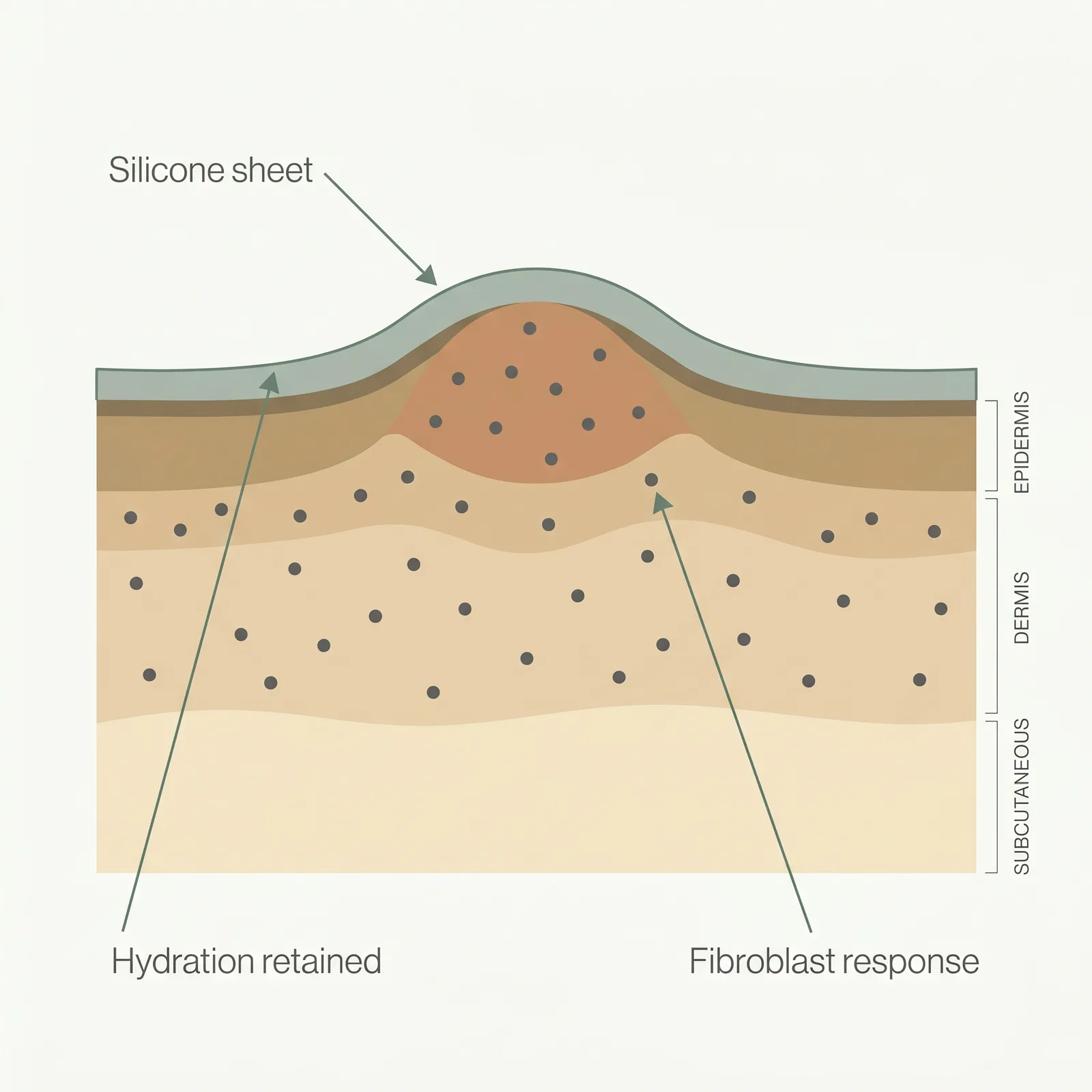
- 1Occlusion. Medical-grade silicone seals the scar surface and blocks excess water loss.
- 2Hydration. The stratum corneum stays hydrated — the signal that tells skin it’s healed.
- 3Fibroblast response. Dermal fibroblasts receive a down-regulating cue and produce less excess collagen.
Typical protocol
Apply 12-24 hours per day for a minimum of 8-12 weeks. Consistency matters more than product brand. Begin as soon as the wound is fully closed.
- Time to results
- Early changes in color and texture in 4-8 weeks; meaningful flattening over 3-6 months.
- Accessibility
- widely available
- Recurrence
- N/A — preventative/adjunct therapy, not definitive
- Insurance
- rarely
Best for
- • New scars (first 6 months post-injury or post-surgery)
- • Prevention after keloid excision
- • People who prefer non-invasive options
- • Facial and chest scars where injections are harder to tolerate
Limitations to know
Combining with other treatments
Commonly used alongside pressure therapy, post-excision steroid injections, and silicone-integrated pressure garments. Pairs well with red-light therapy as a low-friction daily routine.
Evidence sources
International Clinical Recommendations on Scar Management
2002Mustoe TA, Cooter RD, Gold MH, et al. · Plastic and Reconstructive Surgery
Silicone gel sheeting is recommended as a first-line non-invasive option for scar prevention and management.
View source →Silicone Gel Sheeting for Preventing and Treating Hypertrophic and Keloid Scars
2013O'Brien L, Jones DJ · Cochrane Database of Systematic Reviews
Evidence supports silicone gel sheeting for prevention in high-risk populations, though most underlying trials are small.
View source →Updated Scar Management Practical Guidelines
2014Monstrey S, Middelkoop E, Vranckx JJ, et al. · Journal of Plastic, Reconstructive & Aesthetic Surgery
Silicone-based products remain the gold-standard non-invasive intervention for scar prevention.
View source →Effectiveness of Silicone Gel Sheet and Pressure Therapy on Hypertrophic Scars: A Randomized Controlled Trial
2010Li-Tsang CW, Zheng YP, Lau JC · Journal of Burn Care & Research
Combined pressure + silicone outperformed either modality alone on scar thickness, pigmentation, and pliability — supporting the common practice of layering silicone with other protocols rather than using it alone on high-risk scars.
View source →The Efficacy of Silicone Gel for the Treatment of Hypertrophic Scars and Keloids
2009Puri N, Talwar A · Journal of Cutaneous and Aesthetic Surgery
Silicone gel applied twice daily for 3-6 months produced measurable improvement in scar pliability, height, and symptom scores in hypertrophic and small keloid scars, with near-zero adverse effect rate.
View source →
Frequently asked questions
How long each day do I need to wear silicone sheets?
The evidence converges on at least 12 hours per day, with 12 to 24 hours being ideal. Most guidelines recommend a minimum course of 8 to 12 weeks, though many dermatologists extend use to 3 to 6 months. Consistency is the single biggest predictor of whether silicone works for you.
Silicone sheets versus silicone gel, which should I pick?
Sheets work best on flat, stable sites like the chest, abdomen, and limbs and can be reused for 2 to 4 weeks. Gel is better on mobile or contoured areas like the face and joints where a sheet will not stay put. If you need something discreet during the day, gel wins. If you want a single reusable product that adheres overnight, sheets win.
When should I start silicone after surgery or an injury?
Start as soon as the wound is fully closed, usually 2 to 3 weeks after surgery or once the scab falls off naturally. The first 6 months is the window when the scar is most responsive. Starting later still helps but yields slower and smaller improvements.
Do silicone sheets work on mature keloids?
On their own, usually not. Silicone is most useful as prevention and as maintenance alongside other therapies. Mature, symptomatic, or growing keloids generally need clinical treatment like steroid injections or excision. Use silicone to support those primary therapies rather than replace them.
Are silicone sheets reusable and how do I care for them?
Yes, most quality sheets can be reused for 2 to 4 weeks. Rinse with mild soap and water after each wear, air dry, and store on the original backing. Replace when they lose adhesion, tear, or start to peel. Avoid layering creams or oils underneath, which can break down adhesion.
Medical disclaimer
ScarInsight provides educational information about scar and keloid treatments based on published research. This content is not intended to diagnose, treat, or prevent any medical condition. Individual results vary. Treatment decisions should be made in consultation with a qualified dermatologist or healthcare provider who can evaluate your specific situation. ScarInsight is not a healthcare provider and does not offer medical advice.