Red and Near-Infrared Light Therapy
Last reviewed: April 2026
Evidence rating reflects the quality and volume of research — not how well the treatment works. How I grade evidence →
Low-level red (around 630-660 nm) and near-infrared (around 810-850 nm) light delivered at home with LED panels. Painless, non-invasive, and layer-safe — it complements virtually any keloid protocol and carries a second, well-documented benefit set for general skin health.
ShortcutJust looking for device recommendations?Jump to picksHow it works
Red (630-660 nm) and near-infrared (810-850 nm) photons are absorbed by cytochrome c oxidase inside mitochondria — this is photobiomodulation, not heat. Red wavelengths act on the epidermis and upper dermis (around 2-5 mm depth), where lab and early clinical data suggest they suppress over-active keloid fibroblasts, down-regulate TGF-β1 (the main driver of excess collagen), and shift the local inflammatory balance. Near-infrared penetrates deeper (roughly 8-20+ mm) to reach the dense fibrotic tissue beneath established scars, improving microcirculation and calming chronic inflammatory signaling. Because the mechanism is cellular rather than thermal or ablative, the same ATP boost and anti-inflammatory effects also reach surrounding healthy skin — which is why RLT has built a second body of evidence around fine lines, tone, elasticity, and barrier function.
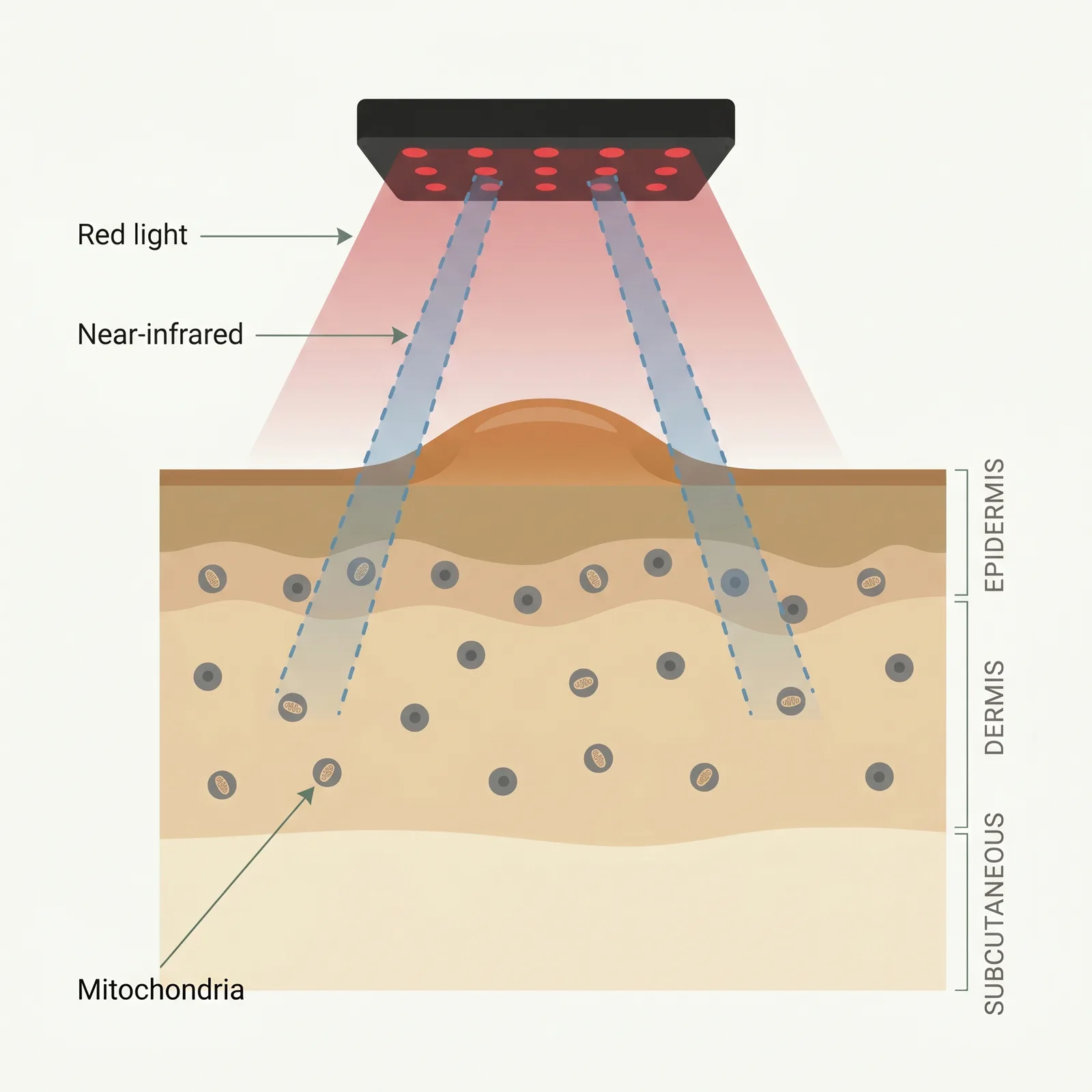
- 1Two wavelengths. Red (≈630–660 nm) and near-infrared (≈810–850 nm) reach different depths through skin.
- 2Depth penetration. Red light acts on the epidermis and upper dermis; NIR penetrates deeper to reach fibroblasts.
- 3Mitochondrial signaling. Absorption by cytochrome c oxidase modulates fibroblast behavior and calms inflammation.
Typical protocol
10-20 minute sessions at 3-6 inches from the device, 3-7 times per week for 8-12 weeks or longer. Irradiance targets vary by device.
- Time to results
- Subtle changes in redness and itch in 4-8 weeks; textural effects reported over several months of consistent use.
- Accessibility
- widely available
- Recurrence
- N/A — adjunct, not definitive
- Insurance
- rarely
Best for
- • Anyone stacking treatments — RLT layers safely on top of silicone, pressure, injections, laser, or post-surgery care
- • People who want a non-invasive, daily-use option with no needles, no heat, and no downtime
- • Those who can't tolerate painful or invasive procedures
- • Red, inflamed scars where calming inflammation and itch is a goal
- • Long-term post-treatment maintenance between clinical visits
- • People who also want the skin-health side benefits: better tone, elasticity, and fine-line reduction from the same daily session
Limitations to know
Combining with other treatments
One of RLT's strongest features is that it layers on top of essentially any keloid protocol without interfering. Used alongside silicone sheeting and pressure for prevention; between steroid or 5-FU injection visits to extend anti-inflammatory effects; after cryotherapy or fractional laser to calm treatment-induced inflammation; and during post-surgical healing to support collagen remodeling. No drug interactions, no conflict with topicals or dressings, and no downtime — which is why it slots neatly into every stack on this site. Some dermatologists pair in-office red / near-infrared LED with fractional lasers for the same inflammation-control reason.
Evidence sources
Low-Level Light Therapy for Scar Management: A Review
2017Hamblin MR · AIMS Biophysics
Photobiomodulation modulates fibroblast activity and inflammation; early clinical data suggests benefit for scar metrics though larger trials are needed.
View source →Effect of 830 nm LED Phototherapy on Hypertrophic Scars
2010Barolet D, Boucher A · Lasers in Surgery and Medicine
LED photobiomodulation reduced scar erythema and improved patient-reported scar quality in a prospective series.
View source →Light-Emitting Diodes in Dermatology: A Systematic Review of Randomized Controlled Trials
2018Jagdeo J, et al. · Lasers in Surgery and Medicine
Systematic review across 56 randomized LED trials (≈4,920 participants) identified 700-850 nm as the most consistently effective range for wound healing and scar remodeling, supporting the use of combined red and near-infrared devices.
Low-Level Laser (Light) Therapy in Skin: Stimulating, Healing, Restoring
2013Avci P, et al. · Seminars in Cutaneous Medicine and Surgery
Reviews broader cutaneous benefits of red/NIR photobiomodulation: increased collagen and elastin synthesis, improved skin tone and fine-line appearance, and accelerated healing — the general skin-health side benefits patients see from regular RLT use.
Frequently asked questions
Which wavelengths actually matter for scars?
Two ranges carry the most evidence: 630-660 nm (deep red) for surface effects on fibroblast activity and TGF-β1 signaling, and 810-850 nm (near-infrared) for deeper dermal and sub-dermal remodeling. Devices that combine both in one panel are the most versatile because keloids have both a surface and a deep component. Single-wavelength devices still work, they just cover less of the scar's depth profile.
Is red light therapy painful or risky?
No. LED photobiomodulation is non-thermal and non-ablative — you feel mild warmth at most. No needles, no anesthesia, no downtime, and no reported interaction with topicals or injections. Adverse effects in the reviewed studies are minimal, limited mostly to transient mild redness in a small number of users. Eye protection during sessions is the main practical precaution.
Can I use RLT alongside my existing treatment stack?
Yes — this is where RLT is most useful. It has no drug interactions and doesn't conflict with silicone sheeting, pressure therapy, steroid or 5-FU injections, cryotherapy, fractional laser, or post-surgical care. Most people run RLT as daily background therapy and keep their clinical appointments on the usual schedule. If anything, it tends to improve how well other treatments are tolerated by calming surrounding inflammation.
Does it help with anything beyond scars?
Yes. The same mitochondrial and anti-inflammatory mechanisms that may modulate keloid tissue also affect surrounding healthy skin. Published trials outside of scarring report improvements in fine lines, tone, elasticity, collagen density, and skin-barrier recovery from regular red / near-infrared exposure — a meaningful side benefit when you're already using the panel daily on your scars.
How quickly should I expect results?
Don't expect visible change in days. Subtle reductions in redness, itch, and tenderness typically show up around 4-8 weeks of consistent use; textural change usually needs several months. RLT rewards consistency more than intensity — short daily sessions outperform occasional long ones, and skipping weeks tends to stall progress.
Medical disclaimer
ScarInsight provides educational information about scar and keloid treatments based on published research. This content is not intended to diagnose, treat, or prevent any medical condition. Individual results vary. Treatment decisions should be made in consultation with a qualified dermatologist or healthcare provider who can evaluate your specific situation. ScarInsight is not a healthcare provider and does not offer medical advice.