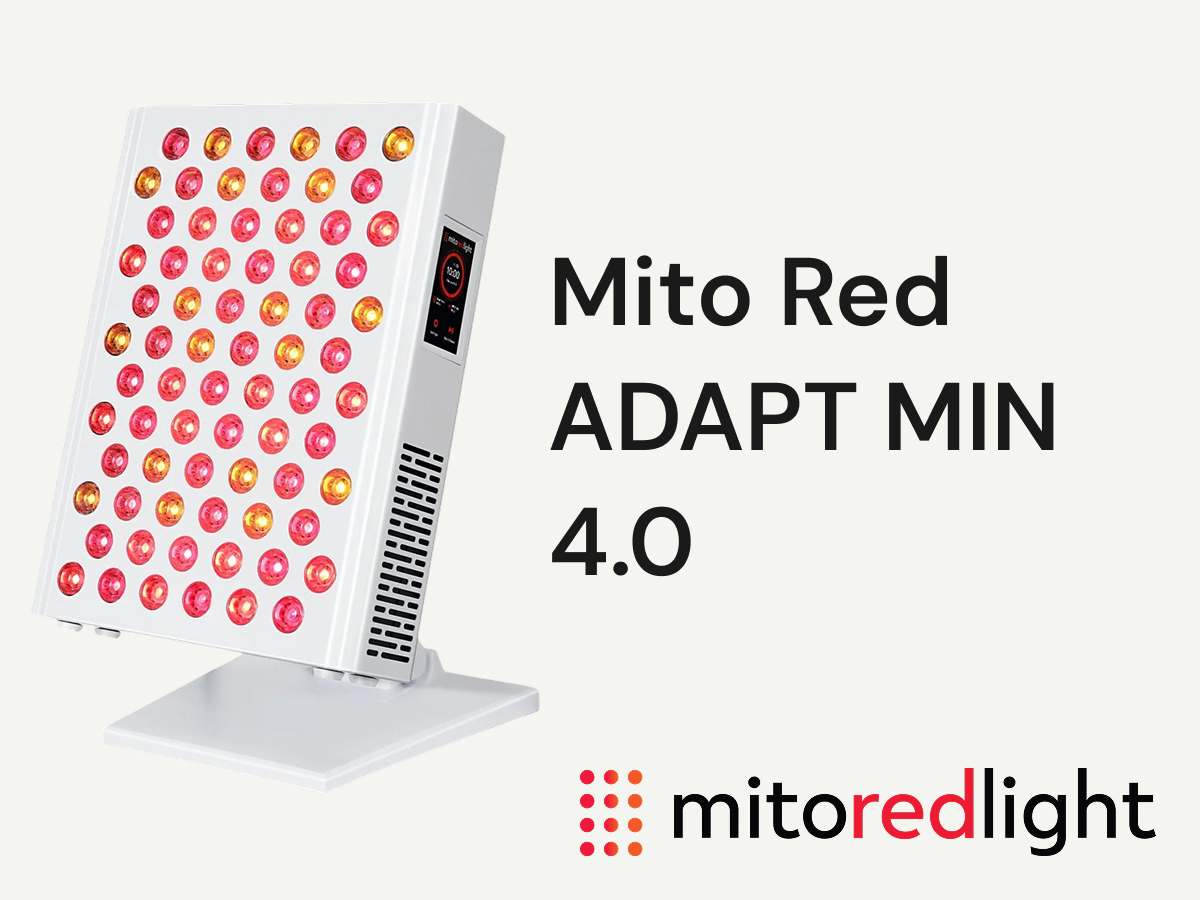
Mito Red Light MitoADAPT MIN 4.0
Eight-wavelength output (590, 630, 660, 670, 810, 830, 850, 940 nm) covers every band studied for photobiomodulation of scar tissue, with patent-pending TruDual circuit architecture delivering 11 selectable combinations at full irradiance. The 630-850 nm core aligns with published keloid and hypertrophic scar research; the 590 nm amber band adds a surface-level inflammation option.
Disclosure: Some links on this page are affiliate links. If you purchase through these links, ScarInsight may earn a commission at no additional cost to you. This does not influence our editorial ratings or recommendations.
Wavelengths and why they matter
For scar modulation, red (630-660 nm) and near-infrared (810-850 nm) are the most commonly studied ranges. Each wavelength targets slightly different tissue depth and cellular mechanism.
- 590 nmamber
Amber light targets superficial skin layers and is studied for inflammation and redness reduction — relevant to early-stage hypertrophic and red inflammatory scars.
- 630 nmred
Red-orange extends the absorption profile in superficial dermal tissue alongside 660 nm.
- 660 nmred
Classic red light wavelength for fibroblast signaling and inflammation modulation in the upper dermis.
- 670 nmred
Deep red wavelength with documented photobiomodulation effects on wound healing and collagen organization.
- 810 nmnear infrared
Near-infrared penetration into deeper dermal layers; commonly studied for scar and wound healing.
- 830 nmnear infrared
Mitochondrial cytochrome-c oxidase absorption peak — core target for photobiomodulation effects on fibroblast behavior.
- 850 nmnear infrared
Standard research wavelength for skin photobiomodulation; deep tissue delivery with high manufacturer adoption.
- 940 nmnear infrared
Far-near-infrared penetrates the deepest tissue layers; evidence for direct scar benefit is less established than 810-850 nm but may support underlying tissue signaling.
Specifications
- LED count
- Verify from spec sheet
- Irradiance at 6 inches
- Verify from spec sheet
- Circuit architecture
- Patent-pending TruDual — 8 independent circuits
- Preset modes
- 11 selectable wavelength combinations
- Beam angle
- Verify from spec sheet
- EMF at 6 inches
- 0 µT
- Flicker
- <1%
- Timer
- Yes
Best for
- • Treating multiple keloid sites in a single session
- • Users who want wavelength flexibility beyond the standard 660/850 nm combo
- • Chest, back, or shoulder keloids
- • Buyers who value patent-pending TruDual circuit architecture for targeted band combinations
Things to consider
Ready to purchase?
Disclosure: Some links on this page are affiliate links. If you purchase through these links, ScarInsight may earn a commission at no additional cost to you. This does not influence our editorial ratings or recommendations.
Medical disclaimer
ScarInsight provides educational information about scar and keloid treatments based on published research. This content is not intended to diagnose, treat, or prevent any medical condition. Individual results vary. Treatment decisions should be made in consultation with a qualified dermatologist or healthcare provider who can evaluate your specific situation. ScarInsight is not a healthcare provider and does not offer medical advice.